
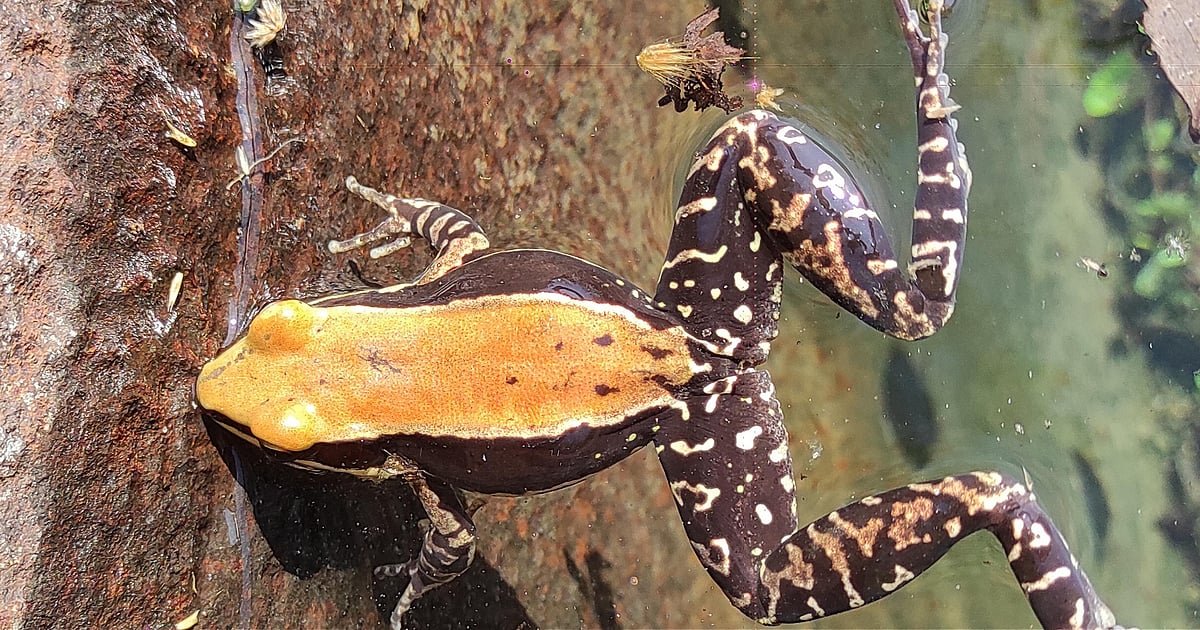
A fungoid frog, locally known as buguṭu kappe, has been discovered in a farm pond on agricultural land in Siddanabavi village, Belagavi district. The amphibian, which is native to the Western Ghats, was identified by experts who noted its distinctive appearance and ecological role.
The species, scientifically named Hydrophylax malabaricus and also referred to as the Malabar Hills frog, features a smooth skin with glandular folds extending from below the eye to the shoulder. Its upper body ranges in color from brownish red to deep crimson, marked by white spots on the sides and upper lip. The frog derives its common name from its resemblance to a fungus.
Biodiversity researcher Manjunatha stated that the frog is primarily found in the Western Ghats of south-west India, stretching from Mumbai to Kerala, as well as in the Malnad and coastal regions of Karnataka. He added that the species feeds on insects and mosquitoes that are harmful to agriculture and the environment.