
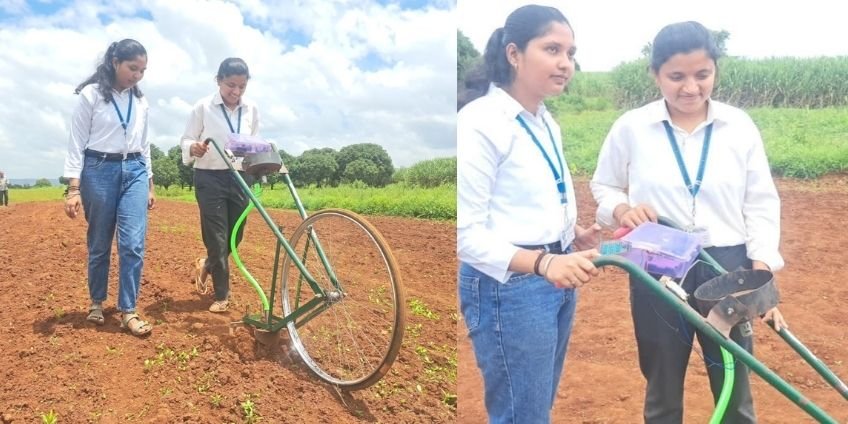
Two final-year engineering students from Belagavi have invented a cost-effective sowing machine, inspired by the struggles of their farmer parents. Their innovation, now patented by the Central Government, aims to ease the burden on small farmers.
Shweta Kapashi of Ugarakhurda village in Kagawad taluk and Sakshi Dhope of Ambewadi are Electronics and Communications students at Maratha Mandal Engineering College, Belagavi. As part of their final semester project, they designed and built the machine, later submitted by professors Dr. D. G. Kulkarni, Dr. Shubha Baravani, and Dr. Kiran Lakkam through the Institute Innovation Council. The device, named ‘So Right Sowing Machine’, received its patent on May 8.
The duo explained that they first created a 3D design, then developed the body of the machine while calculating seed intervals. Using Arduino Uno, sensor-based circuits, a 500 RPM DC motor, metallic plate wheels, and a seed hopper, they ensured accurate seed placement. Powered by a rechargeable lithium battery, the lightweight machine can be pushed easily using a bicycle handle.
In just two months, they built and tested the equipment. It sows seeds one at a time with consistent spacing, covering up to an acre in four hours. The battery-operated design eliminates fuel costs, making it suitable for small-scale farmers.
Currently, the machine is designed for pea, cowpea, and soybean seeds, with plans to adapt it for more crops and even integrate solar charging. “We want to launch a startup to manufacture these machines on a larger scale. Government support would be a big boost,” the girls said.
Their parents’ struggles with costly machinery and labour shortages motivated the invention. While advanced sowing machines cost ₹8–10 lakh, their model was developed for just ₹6,000.
Farmers, including Yashwant Kamble, have welcomed the innovation, calling it practical and affordable. College director Dr. Kulkarni confirmed that the patent ensures exclusive rights, and the management will provide land, facilities, and support to help scale production over the next five years.