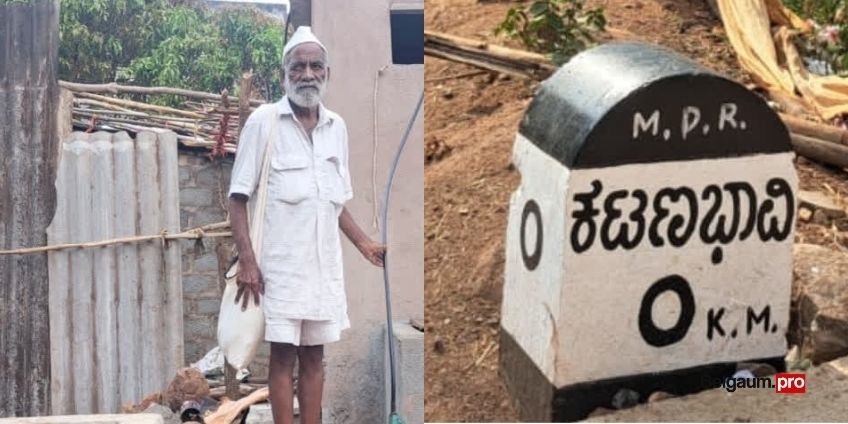
Environmental activist Shivaji Kaganikar introduced villagers to biogas in the 1990s, transforming lives over the years, reports Mohammed Rafiq Mulla.
A village in Karnataka’s Belagavi district has quietly emerged as a model of energy self-sufficiency, standing in contrast to rising concerns over fuel shortages in other regions.
In Kattanbhavi, most households do not depend on LPG cylinders. Instead, they generate their own cooking gas through gobar gas units installed in their backyards.
At a time when global tensions, especially in the Middle East, are causing uncertainty around fuel supply and LPG availability, Kattanbhavi remains largely unaffected. Nearly 85 per cent of the village’s 250 households rely on biogas for daily cooking. With over 200 functional units, the village represents a rare example of grassroots energy independence.
Residents say they no longer worry about empty cylinders or booking refills, as gas is produced at home, ensuring uninterrupted cooking. Many families have consistently used the system for more than four decades.
The village economy is primarily based on agriculture and dairy farming, with most households owning cattle such as cows and buffaloes. Dung, along with toilet waste, is used to generate biogas. A walk through the village reveals units in almost every backyard, quietly fueling kitchens.
Movement Led by Shivaji Kaganikar
Kattanbhavi’s transformation is closely linked to the efforts of 76-year-old environmentalist and social activist Shivaji Kaganikar. In the early 1990s, he launched a campaign promoting gobar gas as a clean and sustainable alternative to firewood.
With support from organisations like Janjagruti Sanstha and Khadi Gramodyog, biogas units were installed in nearly 30,000 homes across Belagavi, Hukkeri, and Khanapur taluks between 1990 and 1995. Earlier, villagers depended heavily on firewood, leading to deforestation and serious health issues among women due to smoke exposure. Kaganikar went door-to-door, spreading awareness about the environmental and health benefits of smokeless cooking.
He recalled visiting Kattanbhavi in 1990 while running a night school. “People were cutting trees from nearby hills for firewood. I explained the environmental damage and health risks. With financial support from voluntary organisations, households with cattle began installing biogas units,” he said. Today, around 225 homes actively use the system.
Villagers recall that his efforts initially faced resistance, with some even throwing slurry at him. However, he remained persistent and eventually brought about lasting change.
Savings, Safety and Sustainability
For residents, biogas offers benefits beyond convenience. Villager Bhairanath Kotekar said his family has been using gobar gas for four decades. “Earlier we had four to five cattle, now we have just one, yet gas production remains sufficient. We mix dung in the tank and connect it to the toilet outlet. While others worry about cylinder shortages, we do not,” he said.
Farmer Maruti Kotekar, who installed a unit four months ago, said the decision has been rewarding. “Cattle dung was going to waste. Seeing others use gobar gas, I installed one for ₹24,000 with subsidised materials from a local organisation. With reports of gas shortages elsewhere, I feel it was the right choice,” he said.
Homemaker Mallavva Pavale highlighted both financial and safety benefits. “We add dung to the tank twice daily and get enough gas for cooking. There are no LPG bills, so we save money, and there is no fear of explosions,” she said.
A Model Worth Replicating
Sriram Kamath, secretary of the Belagavi Khadi Gramodyog Sangh, said awareness drives and government subsidies were key to the initial spread of biogas units. Households built the units themselves using subsidised materials like bricks, sand, and cement.
Kaganikar noted that widespread availability of subsidised LPG has reduced biogas usage in some areas, which he considers a missed opportunity, especially as India continues to rely on fuel imports.
“Despite having the resources and knowledge to produce gas locally, we are not fully utilising it. Both Central and state governments should promote biogas units among farmers with cattle and increase subsidies. This can reduce dependence on external sources and strengthen energy security,” he said.
Kattanbhavi’s example shows how simple, locally driven solutions can provide long-term answers to global challenges.