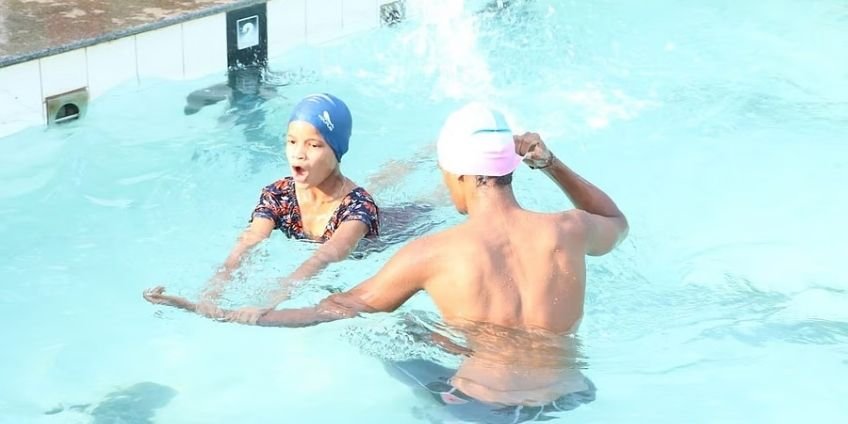
Every special child trained by the team is provided nutritious food supplements such as fruits and nuts, along with free swimming gear, transport facilities and health support.
In 2009, 11-year-old Moin Junnedi faced repeated rejection from schools in Belagavi. Suffering from brittle bone disease, even a small fall posed serious risks, making institutions reluctant to admit him. In a bid to secure his education, Moin and his mother went to meet the Karnataka chief minister, who was scheduled to inaugurate a programme at a swimming pool. They arrived after the chief minister had left, but there they met a swimming coach who would alter Moin’s life forever.
Umesh Kalghatgi, known for coaching children with physical challenges, noticed Moin’s interest in swimming and decided to train him with extreme care. Within three weeks of disciplined practice, the one-and-a-half-foot-tall Moin, who has severe physical deformities, was swimming independently. He later won two medals at the 2010 National Paralympics and earned the title “Wonder Boy of India.” Now 28, Moin has secured several national and international medals and completed his BCom degree.
Moin’s story is one among many. Raghavendra Anvekar, who has polio-affected legs, once struggled to survive in Belagavi, living in a small room with his family and taking up odd jobs. In 2000, he joined Umesh’s swimming camp. Today, he has won 117 medals, including a bronze at the Asian Para Games, and is gainfully employed.
Over the past 25 years, Umesh Kalghatgi and his team, under the Swimmers’ Club Belgaum and Aquarius Swim Club of Belagavi, have provided free swimming coaching to hundreds of children with physical, intellectual and sensory disabilities, enabling them to lead dignified lives. Among his trainees, Atish Jadhav has won three international and 16 national medals; Rajesh Shinde has crossed the English Channel; Shridhar Malagi has secured 26 international and 57 national medals; and Umesh Khade has earned 55 national medals. Several have also found jobs through the sports quota.
Beginning of a journey
Umesh began his career as a swimming coach in 1987. His voluntary work with an organisation for the welfare of the differently abled in Belagavi motivated him to work more closely with special children. In 2001, after being approached by a group of such children, he trained his first batch of six students, including Raghavendra Anvekar. Their enthusiasm and determination deeply influenced him.
Over time, Umesh and his club introduced a three-week basic swimming camp for special children every February, which has now become a key feature of the programme. Each year, about 300 children, mainly from Belagavi district, participate. Over two decades, a team of 25 trainers, including persons with disabilities, has trained more than 6,000 children. “We identify talent in the basic camp and then train committed children throughout the year,” Umesh says.
All support services, including nutrition, equipment, transport, and medical assistance, are funded through philanthropy and corporate social responsibility initiatives. “Swimming has given our children courage and confidence,” says Anita Gawade, headmistress of Maheshwari School for the Blind, noting that at least 250 of her students have trained under Umesh over the past two decades, many of whom won national medals.
Training children with special needs presents unique challenges. “Every child is different. Like parents, we first earn their trust. Once they feel safe, they learn to swim within weeks,” Umesh explains. Coaches are specially trained to address varied needs with patience and empathy. Convincing parents can also be difficult. “We consult doctors when required and reassure parents. Even Moin’s mother was initially hesitant. Seeing her tears of joy when he won a medal made everything worthwhile,” he recalls.
Raghavendra, now a coach himself, highlights the adaptive training methods. “Swimming depends on coordination and breathing. Since I don’t have strength in my legs, I rely on hand gestures and verbal instructions while coaching,” he says.
The impact of Umesh and his team extends beyond medals. “Many institutions train skilled swimmers, but developing them from the grassroots is crucial,” says S R Sindhia, secretary of the Paralympic Swimming Association of Karnataka. “Belagavi’s Paralympic swimmers, particularly the visually impaired, form a significant part of the state team and bring pride to Karnataka each year.”
Camp for special children
Two decades after training his first batch, Umesh continues to expand the programme. This February, the club will conduct its 24th training camp. Former trainees like Raghavendra now return as coaches. The programme focuses on technique, safety and discipline, working closely with schools, community groups and organisations to reach children from diverse backgrounds.
“My aim is to build a professional and inclusive space where every child feels supported,” Umesh says. Sportsperson and entrepreneur Avinash Potdar adds that Umesh and his team have created opportunities for inclusion and empowerment, helping hundreds of children realise their potential and independence.
For Umesh and his team, the journey continues. Each stroke, lap and medal symbolises perseverance, compassion and the power of sport in building a more inclusive society.