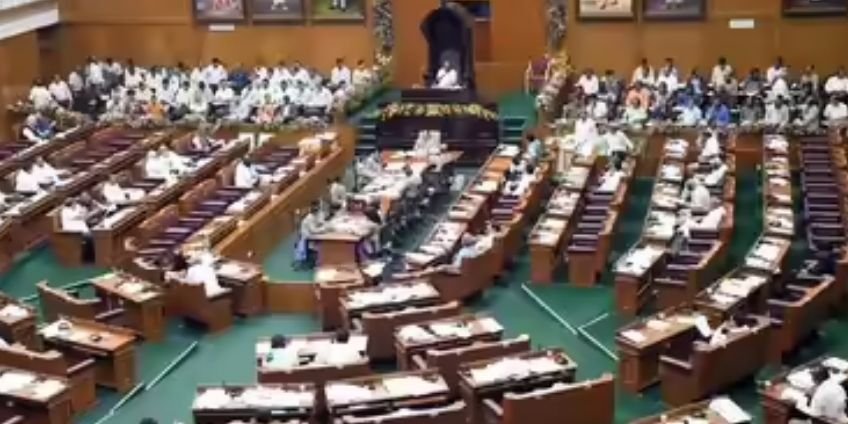
With the issue of internal reservation for Scheduled Castes still unresolved, organisations representing Other Backward Classes (OBCs) have renewed their call for reclassification of categories in local bodies. Community groups are gearing up for a statewide outreach, while OBC legislators across parties plan to raise the matter during the winter session of the legislature beginning next week. Unlike SCs, who have political representation in both Parliament and the legislature, OBCs receive such quotas only in local bodies. The renewed pressure comes as the government faces mounting demands to conduct long-pending elections to urban and rural local bodies, including the Greater Bengaluru Authority, and zilla and taluk panchayats.
“Congress only talks about social justice; when it comes to implementation, it delivers the opposite,” alleged Karkala MLA and BJP OBC leader V Sunil Kumar. He said the government’s “half-hearted” attempt to provide internal reservation to SCs is stuck in court, while it has not addressed demands from STs. “Now OBCs, who make up 54% of the population, are stranded because of the government’s reservation policy for local bodies,” he added.
OBCs currently enjoy 32% reservation in education and employment and are grouped into five categories: 1, 2(A), 2(B), 3(A), and 3(B). However, the 33% quota in local bodies is restricted to only categories A and B—an anomaly that, critics say, limits representation to just 156 of the 802 OBC castes. Following a Supreme Court directive to collect empirical data on OBC reservation in local bodies, the previous BJP government set up a commission in May 2022 under retired judge Justice K Bhaktavatsala. In its October 2022 report, the commission proposed four categories—1 and 2 with 9.9% each, and 3 and 4 with 6.6% each.
Though the Siddaramaiah-led Congress government accepted the report in October 2023, it later reinstated the older two-category system. “The purpose of forming the commission was to correct disparities and ensure fair opportunities for all castes, but the government chose to retain only two categories. That was their decision,” Justice Bhaktavatsala said. The two-category model was first implemented in 1996 by the JH Patel government based on recommendations submitted by Siddaramaiah when he was deputy chief minister. Critics argue the model favours a small number of castes, leaving many without representation.
“The current categorisation denies OBCs true social justice,” said Vadiraj, convener of the Forum for Social Harmony. “The government must implement the Bhaktavatsala report. We are preparing a constructive campaign with a round table and symposium.” Congress MLC DT Srinivas said OBC legislators in the ruling party support the demand. “Our government under Siddaramaiah is committed to social justice. We are confident the chief minister will address these disparities,” he said.